
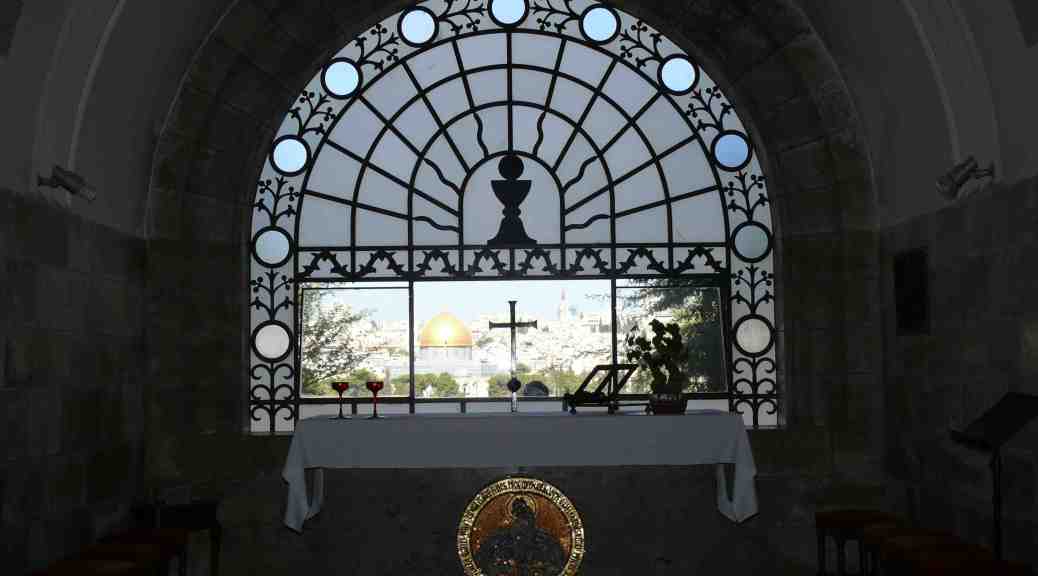
Lynda has been updating you regularly with a very vivid account of our itinerary throughout Nepal and the Holy Land. As we prepare to leave the Holy Land here are a few of my reflections on these remarkable places. There have been new learnings as well as a reinforcement of previous held convictions.
The new learning has been the incredible tolerance there is here in Israel with a great diversity of cultures, religions and outlooks. We have seen ultra orthodox Jews (in all of their fine Jewish dress) happily walking through the Muslim quarter of Old Jerusalem. We have stayed in a Jewish hotel which employed a waiter by the name of Mohammed who is an American Muslim from California. Our Tour Guide was Jewish and our Driver was a Muslim. Jerusalem has 512,000 Jews and 302,000 Arabs and I’m not sure how many Christians but I would think a reasonably small number. There are synagogues, mosques and churches all evident. There are obvious tensions with armed guards often seen but in recent times there has been very little violence. Galilee is very relaxed and Tel Aviv is a modern bustling city like any other with a surprising lack of obvious security. So my new image of Israel is a Jewish society with a remarkable ability to combine the old with the new and tolerate diversity.
My settled conviction which is now even stronger is the truth of the gospel of grace. My heart’s prayer as we moved around the Middle East was that people would turn to the gospel of grace.
Everywhere we looked there was the way of religion – praying in front of the Western Wall and hoping for a third Temple to be built, hearing the loud call of the minaret calling the faithful to pray five times a day and many churches and shrines built on what are known as “traditional sites” which means hardly likely to be the actual site.
In contrast to this is the gospel of grace. It is there in the Old Testament as well as the New. Abraham is called not because he is special but so that God might have a people through whom he will show his holiness and grace in the world. Moses is a very reluctant starter but God uses him to bring about the exodus. The people are confronted by the Red Sea on one side and Pharaoh’s army on the other and God says to the people all you need to do is be still and you will see the Lord’s deliverance. David says to God let me build you a house [a Temple] but God says to David I want to built you a house [a Household]. From this household will come a son of David who is the Messiah. In the Old Testament God is the one who takes the initiative, God delivers his people, God saves, it is all of God’s grace. On our trip we have had the privilege of seeing Abraham’s gate,standing on Mt Nebo where Moses looked out over the promised land and looked at the ruins of David’s palace.
The New Testament of course is full of God’s grace. It is all wrapped up in Jesus’ obedient life, remarkable teaching, death on the cross to pay the price of sin and victorious resurrection. Jesus is Messiah, Saviour and Lord. Through faith in him we are completely justified and have open access to God. The Gospel of Grace is about God reaching down to us rather than us trying to reach God through being religious. All other religions and world views could be summed up in the word “do”. You through your piety and good works redeem yourself. The Gospel of grace can be summed up in the word “done”. Christ has done everything necessary to justify us through his death and resurrection. We no longer have to justify ourselves!
This gospel of grace of course requires a response from us. If God has shown his total commitment to us in the promise of a Messiah and then the fulfilment in Jesus then nothing less than total commitment from us is the obvious response. This is a total commitment of love. It goes way beyond the rules and rituals of the religious way to God. It is a love which breaks your life but at the same time makes your life. Jesus said,” He who seeks to save his life will lose it and he who loses his life for my sake will find it.”
The Holy Land is a remarkable place full of contradictions and ironies. I have learnt many new things but most importantly I have delved deeper into the Bible and become more convinced about the gospel of grace and how much our world desperately needs to find this better way.
Nepal is a land of incredible contrasts and ironies. It has beautiful mountains and beautiful people and yet it has just gone through a civil war where Nepalis have been killing one another. How could they commit the horrible atrocities that have been reported? The Nepalis we met were very gentle and retiring people. In the Church especially we shaw dedication, commitment and love.
Nepalis take great pride in their personal appearance. We often saw people bathing at public taps with clothing being washed as well. Women wear brightly coloured saris and school children walk to school immaculate in their school uniforms. Yet Nepalis don’t take the same pride in their homes and neighbourhoods. Rubbish is left on the streets and roads are in a very poor state of repair. Houses are often left unfinished. Poor Nepalis live in sheds with corrugated iron roofs held on only by rocks and bricks.
Traffic in Nepal is chaotic. In the bazaars people, bicycles, rickshaws, motor scooters, cars and buses all compete for limited space. Add trucks to that equation on the open highways and you can imagine the chaos. Horns are regularly used either to let other drivers know you are in their blind spot or to express your dissatisfaction with another driver. Yet when you understand how it all works you realise the drivers are really looking out for one another.
The missionaries are very inspiring. At the Tansen Hospital the motto on the hospital sign says “We Serve, Jesus Saves”. And serve the missionaries do, in very hot, cramped conditions. Tansen Hospital has people everywhere and it is confusing to work out who are patients and who are staff. Only in the large outpatients waiting room does the crowded rows of seats make it obvious who are the ones waiting to be seen. At Green Pastures hospital in Pokhara, the pace is much slower. Being a leprosy, rehab and palliative care hospital it occupies spacious grounds with buildings, both one and two storey, connected by walkways, and some new buildings appearing. The commitment of the missionaries in these places is making a real difference.
I don’t know how government works in Nepal but everywhere there is evidence it could work a lot better. Roads are in very poor condition, electricity wires are a tangled mess, there seems to be few if any social services and no garbage collection. In our travels we saw buildings labeled The Department of Information and the Department of Money Laundering Investigation but no Department of the Environment (pollution from trucks was especially disturbing).
Poverty is all around yet the people are not depressed. There is evidence of enterprise with most people setting up some type of shop on the ground floor of their house. Even the homeless put out a mat and try to sell a few bits and pieces. There is poverty but the people are not without hope.
It seems to me what is needed more than anything else is leadership. Agreeing on a fair and just constitution coupled with visionary leadership that has integrity would make a huge difference. From a closed Hindu kingdom to a secular democracy in a few short decades, Nepal has taken great strides forward. The hard work of missionaries and the growth of the indigenous Christian Church has been a major part of that progress. May the beautiful people of Nepal rise up to the full stature of the mountains which embrace them and find their place in the Kingdom of God.
 Chris and Lynda Johnson