
PRAGUE
The Czech Republic came into existence in 1993 when it and Slovakia parted company from the previous Czechoslovakia. Prague, the capital, is a very old and beautiful city on the Vltava River, gracefully inhabited by magnificent white swans.
Similar to Budapest, one side of the river is flat and the other side is hilly, with the castle precinct on the top. The famous Charles Bridge is stunning with its towers on each end and 30 statues along the sides. It is now purely a pedestrian bridge, with various musicians along the way, portrait painters, jewellery sellers and beggars. As we walked the city we saw the Jewish ghetto with the old Staranova Synagogue. From this area 80,000 Jews perished in the holocaust. The narrow cobble-stoned streets wound their way through medieval houses, shops and halls, all at interesting angles which at times block the pedestrian view of one from the other. The small square in front of the Town Hall is surrounded by so many other grand buildings including a church.
There is a great tradition in Prague of Marionette Theatre and in our relatively short walk we passed two marionette theatres which have given centuries of joy to countless children.
The decoration of building facades with pretty paintings often depicting the trade of the shop owner is commonplace around central Europe and Prague was no exception. Some were pure decoration, some used cubism, some depicted the trade of the owner. As we entered the central square with the Town Hall building, we were there at midday to witness the famous astronomical clock with its rotating apostles, and the skeleton pulling the bell to announce to all around that their time of death is now one hour closer! Because we were there on the first Wednesday of the month we also got the added extra of a siren call as well.
This main square was a bustle with street theatre, busy Prague dwellers, sauntering tourists, and police as there appeared to be an important dignitary visiting. We encountered this especially as we left the little spot we had lunch and walked straight into a cortege of black cars with tinted windows, a TV camera and reporter, security guards, and a couple of extremely well-dressed gentlemen greeting each other as one exited the car and was speedily taken inside a building. I decided it was wisest to keep my camera well and truly down! But interestingly, we encountered them again later in the afternoon in the castle precinct as we had to divert our route because they apparently took precedence.
We wandered through the great little markets of Wenceslas Square, dedicated to King Wenceslas the one whom the Christmas Carol is written about.
I also learnt a new word while visiting Prague … defenestration. It seemed to me that this is simply a way of sanitising ‘murder’ as it is the act of throwing someone, with whom you disagree, out a window! This was popular a couple of times in Prague’s history, and it is thought that altogether about 14 people were defenestrated, including several bishops! Mmmmmm.
Jan Huss, a reformer in Prague 100 years before Luther, called for similar reforms to Luther, and was burned at the stake for his efforts. Today the majority of the country is Roman Catholic, with 10% evangelical protestant, but in reality the Czech Republic is one of the most secular countries in Europe and the churches only have a handful of worshippers but thousands of tourists.
After lunch we went up the hill to the castle precinct and was again mesmerised by the ornate interior of St Vitus’ Cathedral built beside the castle. It was certainly architecturally stunning, but with huge tombs dominating both the nave and the sanctuary area, we really wondered who the people were worshipping. It was an interesting feeling though to be walking on 14 bishops buried under the stone floor.
We walked through a couple of rooms of the castle, Vladislav Hall, a huge area, beside where the current office of the President is in the old castle. Vladislav Hall was used for receptions and off to the side was the Diet, where the King and parliament of Lords and Bishops would meet [if they hadn’t been defenestrated that is!]
We finished our afternoon of walking by visiting what is called the Golden Street – a tiny row of several medieval houses, which were amazing to walk through! This was followed by the changing of the guards at the main gate which I tried to video. Unfortunately a delivery van drove out right in front of me at the time, and then when the video was restarted a bee decided to buzz in front of the camera! Attempts foiled, but good fun!
We left the castle area walking through Wenceslas Vineyard which gave wonderful opportunity for beautiful vistas across Prague, a city worth more days to visit.


MUNICH
On our drive from Prague to Munich the fog didn’t lift all morning. The weather was quite mild but the sun obviously wasn’t strong enough to lift the fog until the afternoon. Arriving at Munich we passed the 1982 Olympic stadium which brought back memories of the horrific terrorist attack with the murder of some Israeli athletes. A truly disastrous event to happen on German soil.
We had some time at Nymphenburg Castle, the summer residence of the royals with magnificent gardens at both front and rear. More breathtaking moments. We drove through the city centre and wandered around Marienplatz, ascending another church tower to get great views of the city, and then taking a stroll through a nearby market full of people.
Our evening in Munich was spent visiting the famous Oktoberfest. We wandered around for a while with the hordes of other people, taking in the festive atmosphere. It was very obvious that some people were more festive than others, and weren’t dealing with it very well! We quickly found out that there was no way we could find a table anywhere, and didn’t feel like joining a queue that would have lasted hours, so retreated to a restaurant up the street for a much quieter dinner even with a full house there. Oktoberfest celebrates the end of the hop season and the new beer for the season, but was originally a wedding celebration for Crown Prince Ludwig in 1810, which was so popular that it was repeated annually, and has developed through various stages, but always held in the same area called Theresienwiese, after Ludwig’s new wife, Princess Therese.


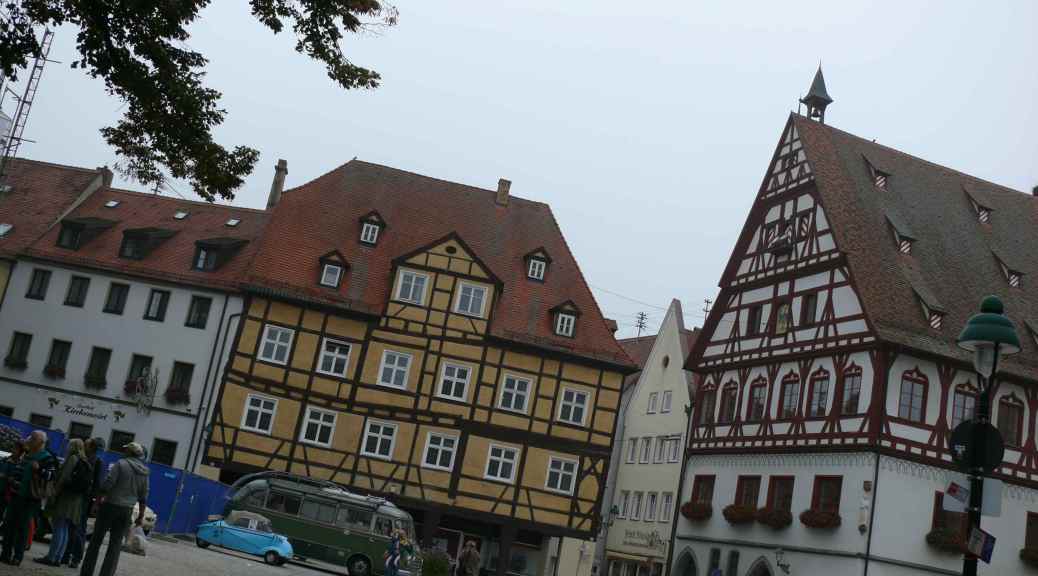
The next day of travelling back to Frankfurt was a very special day. Again it began with thick fog, which eventually turned into a warm sunny day. Our journey joined the ‘Romantic Road’ halfway along its 410 km and we visited the exquisite little medieval town of Nördlingen, with old houses, city wall, churches and shops. It was very quiet for a bank holiday, but we were soon joined by a small group of people driving by in classic cars. Such a treat to see! We wandered around for quite a while and every turn gave us a new joy and smile, as we saw houses built in the 17th century, leaning on one another, and tiny little shops that have been in operation for so long. We found the local evangelical Lutheran church door unlocked and were treated to the organist playing as we had a good look round.
Our next stop brought us to Rothenburg, another medieval town, built in a circular pattern, with the city wall still in tact for the full circumference of the town. Rothenburg was built in the 13th century on the site of a meteor crater from millions of years ago. It has retained its medieval character with little change over the centuries. We visited a world famous Christmas shop which operates all year round, selling a huge range of Christmas decorations, gifts, linen, toys, dolls and trees. Way too expensive to purchase, and impossible for anything to travel well anyway.
There was a tower to climb, so we climbed the tower. This has certainly become the trade mark for us of this part of Europe. The town hall has a bell tower with some of the narrowest steps and ladders we have encountered, but the view over this circle of a town was well worth it. We had a great lunch at the Cafe Conditorei, which included some more exquisite German cake, which very adequately rounded off our tour of Central Europe.


 Chris and Lynda Johnson