
Venice | Assisi | Rome | Florence | Montecatini | Pisa
The journey from Austria to Italy took us through more beautiful terrain as we drove from the mountains on to the plains. Anticipating Venice, after hearing about it for years, did not prepare me for the reality. Crossing the low bridge as we approached the Venice lagoon, it was an incredible sight to see the shallow water which just seemed to gradually emanate from the mainland. The only access to the Venetian islands is by boat, so we boarded our water bus. The Queen Elizabeth cruise ship was docked as well, which we quietly greeted and smiled, as we did when we saw it in the Port of Piraeus in Greece. The sky was a little hazy so our views were not as great as they could have been, but it was quite surreal to pass the iconic landmarks so often photographed.
The uniqueness of this ancient city is unparalleled, and our walk around was breathtaking at every corner. We did the obligatory gondola ride from which you could see that ‘ordinary’ life, of a sort, with washing hanging out from the windows above the canals. We walked past glass-blowing shops, clothes shops and leather shops, as well as hardware stores, kitchenware shops and hairdressers. ‘Ordinary’ life it is, and ordinary life it isn’t.
We went through the great St. Mark’s Basilica and were in awe. The floor was so uneven, with dips and rises, obviously brought about by the age and uneven foundations. We enjoyed a cup of coffee in a little restaurant, and then continued our walk. To our surprise we walked onto an island with gardens and parks and a wide pedestrian street … it’s not all little lanes and alleys to get lost in! Overall though, Venice is looking unkempt, with buildings in disrepair, needing some loving care which even a coat of paint could fix. I’m sure part of the appeal is the visual appearance, but dirt and window shutters falling off could so easily be taken care of as part of general maintenance. There doesn’t appear to be a ’code’ that residents must adhere to. This was, of course, in contradiction to the obvious money that comes to Venice as we walked past the many huge and opulent personal yachts and cruisers in the Grand Canal.


The next day we journeyed south through Tuscany and Umbria and came to Assisi, the home of St Francis. This quaint medieval town is built on the side of a hill, again with many lanes and alleys to get lost in up and down the hillside. The great Basilica, an upper and a lower one, called the ‘superior’ and the ‘inferior’, made us wonder what the simple St Francis would be thinking if he saw it now. His tomb is located in the crypt.


![Basilica [Superior] Assisi](https://i0.wp.com/chrislyndajohnson.net/wp-content/uploads/2014/10/p1190768.jpeg?ssl=1 "P1190768")


Arriving in Rome, founded by Romulus in 753BC, there was again great anticipation, having heard of ‘the eternal city’ all our lives. However our arrival at the hotel really set me on edge as we were treated so poorly, it would not be an understatement to say even treated with contempt. A nice dinner at a little local restaurant made me feel better and the next morning we were off to the Vatican Museums, the Sistine Chapel and of course, St Peter’s Basilica and Square. You could say these certainly didn’t disappoint, as they lived up to every expectation we had. The art, the tapestries, the ceilings, the statues … all were amazing as we walked through the great halls of the museums. The exquisite paintings of the Sistine Chapel were explained to us before we entered, and we saw firsthand the amazing work of Michelangelo. The methodical nature of the retelling of Creation and the Fall through the ceiling painting was absolutely amazing. The way Michelangelo painted first the section frames and pillars before painting each section with its intricate colours and story truly shows his inspiration. To hear that he resented doing it because his first love was sculpting was also amazing, and moreso that he reluctantly returned to do the Last Judgement painting on the sanctuary wall on the request [read demand] of the Pope. He left his mark in the painting, with his self-portrait in the removed skin of St Bartholomew, who according to tradition was skinned alive, and also in the awkward representation of one of the then Cardinals, with whom he had a major disagreement, and banished him to hell with a serpent wrapped round his body with the mouth of the snake firmly gripping the Cardinal’s genitals. Not a good way to spend eternity in hell. Note to self – stay on Michelangelo’s good side.
St Peter’s was as expected … big and elaborate. We appreciated it for what it was, but as in Assisi, we couldn’t help but reflect on how Peter himself might react, a humble fisherman in service of his Lord, who began as an impetuous and bumbling disciple gradually growing in boldness and courage as the Spirit took hold of him. We thanked God for the current Pope who has refused to live in the palatial papal apartments, but instead lives in one of the humbler apartments to the rear of the Vatican. We also thanked God for his stance to bring the church into a loving, caring, more simple and Jesus-focussed future. May this be the will of God for not just the Roman Catholic Church, but the whole Christian church around the world.
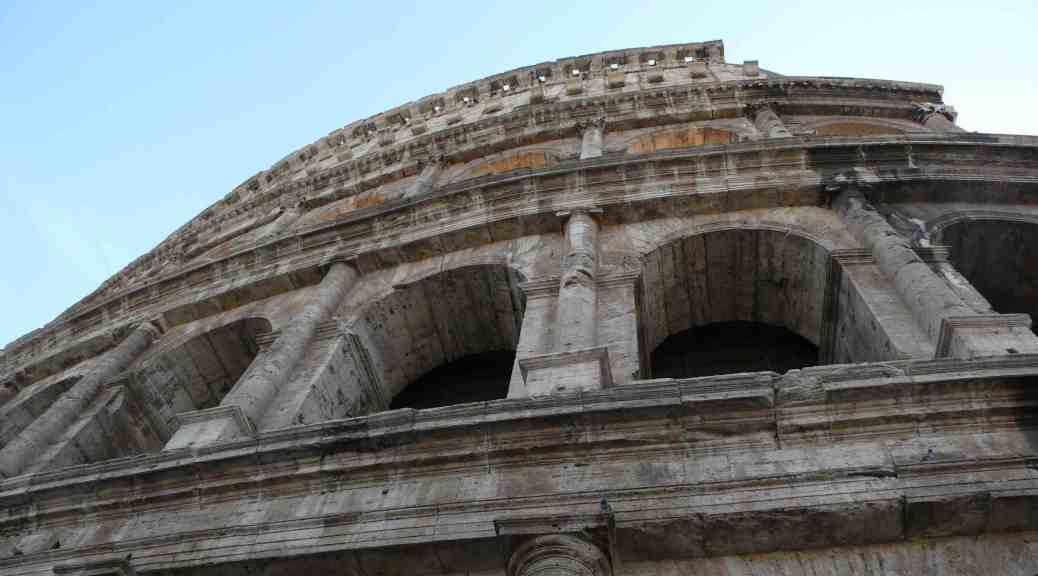
Our afternoon was spent exploring other great monuments of Rome. The Colosseum was amazing as we used our imagination to go back 2,000 years. The underground dens where the animals, slave fighters and gladiators were kept prior to the Games, are all exposed now as the main floor has disappeared. To find out about an intricate lifting winch system which magically brought the gladiators through the arena floor ready for battle was another reason to admire not only the resourcefulness of the Romans, but also the engineering know-how. The original ‘arena’ [meaning sand] got its name from the floor being covered with sand to absorb all the human and animal blood spilt during the Games.
When the Colosseum was of no further use due to the Games being cancelled around AD520 it was decreed that the public could come and take the marble overlay for reuse. This now means that all the original exposed walls have holes where the iron rods held the marble facade onto the structure. We tried to imagine it in its original glory and felt saddened the decision really brought about the demise of this grand structure. It was further destroyed in the 18th century when a massive earthquake took down the majority of the outer wall. The Colosseum is now used at times for huge papal services, which is why there is now a simple cross in view at ground level.
The Roman Forum was a short walk away where we viewed the remains of so many temples, some of which were converted into churches, the ruins of Caesar’s Palace, the City Hall and the Justice building. We walked to the Pantheon, also converted into a church, and then just stumbled upon the magnificent Church of St Ignatius, which actually awed us more than St Peter’s! It was simply stunning. We traced our way through other squares, confusing lane ways and more churches, passed so many street-sellers trying to sell us contraband rubbish, until we reached the River and crossed the bridge straight towards Castel San Angelo. Regrettably, knowing that the Trevi Fountain is under total renovation, with no water and all the statues covered, we chose not to even go and have a look but to use our time in other areas of town. Perhaps this means that Rome is worth another visit, but that’s a hypothetical for another time. We enjoyed a reasonably cheap meal before we hunted out the public transport to get us back to the hotel.


The next morning was another early start to get to Florence, the home of the Renaissance and the city that gave the Italian language to Italy. Another gem to absorb. Florence is known for its leather goods and it was hard to ignore as about every second shop sold beautiful leather products. We saw a demonstration of magnificent leather craftsmanship and how the gilt patterns are applied.
Certainly the gems of Florence [Firenze] are many. We saw the church where Michelangelo and Galileo are buried, the incredible Duomo [Cathedral] with its baptistry and bell-tower totally covered in white, pink and green marble. What a spectacle! Tower houses with main doors on the second level are a fascinating glimpse into medieval life, and with Florence being the birth place of Dante there are many allusions to his life and impact.
The replica of Michelangelo’s David is also a sight to behold, standing in the position where the original was placed in 1504. To prevent further weathering the original was moved inside in 1873, but unfortunately time constraints didn’t allow us to wait in a queue to pay the entrance fee to see this incredible work of art inside the Galleria Dell’Accademia. Another time. But there are also other original sculptures close by which reveal the incredible skill that can form multiple figures out of one piece of marble, telling a story of history, love, rivalry and passion.


Our overnight stop was in Montecatini, which gave us a wonderful opportunity to meet up with new friends, David & Winnifred, who drove a couple of hours to meet us. 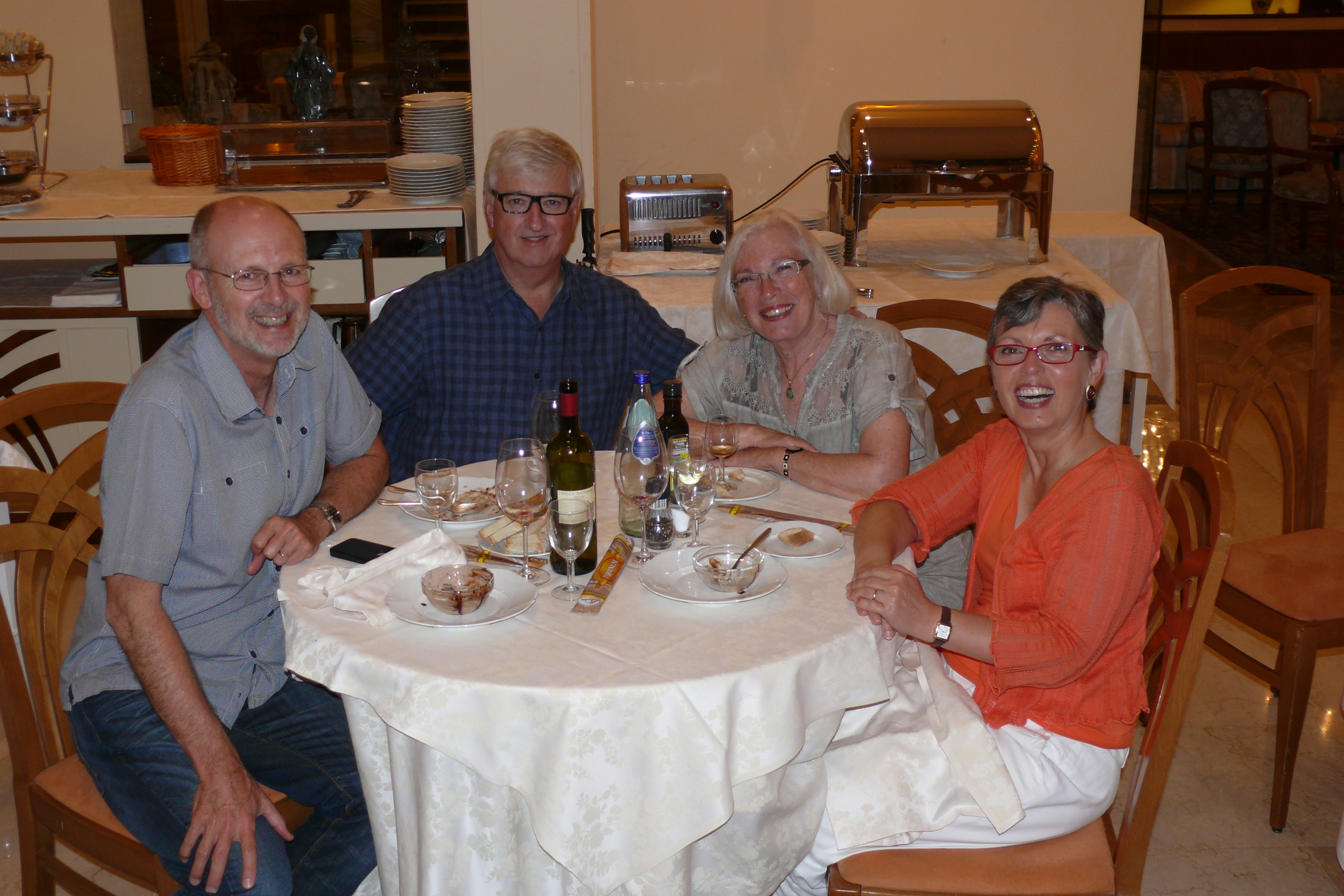 Our daughter Clare will soon be married to David’s son, Dylan, so it was great that our paths could cross while we were relatively close to their home town. They have moved from Australia to Polinago in central northern Italy to run a B&B. We had a fantastic night with wonderful conversation over a superb Tuscan dinner! We would certainly love to return to their part of Italy and spend time with them at Cherry Tree House.
The next morning we stopped at the must-do Pisa and were amazed by this beautiful structure, and its companions of the Baptistry and the Duomo. This amazing bell-tower experienced subsidence during a gap in the early building process which resulted in the lean. Over the centuries the lean increased to an incredible 8.5o, and got to the point where the decision was taken to close it due to safety reasons. The international engineering community got together in the early new millennium worked its magic to correct the structure by 5o to its current lean of 3.5o and it has now been declared safe for public climbing access for the next 300 years!


We then drove north through beautiful countryside of rolling hills, and even though the weather turned dark and rainy it was still wonderful to see the pretty little villages all perched on hilltops in their characteristic peach, cream and yellow colours with a church steeple towering over the houses. We passed by the Italian Riviera on the north west coast, passing easily through the mountains and valleys on the ‘Highway of Flowers’ with its more than 100 tunnels through the mountains emerging into valleys where the road smoothly continues onto high bridges making very easy an otherwise difficult journey.
Our fleeting four days in Italy were over and our taste for more, especially for the ‘real’ Italy, has begun.
Even though it was raining and windy, we had wound our way through the mountains, and we saw the vista of the French Riviera. The next four days of France awaits!
 Chris and Lynda Johnson