
What a shame to leave Scotland so soon! But there was so much beckoning us southward. We had a couple of nights booked in Durham and also wanted to try and see the Holy Island of Lindisfarne on the way south. Fortunately the tide times were well-timed for us, as Lindisfarne is only accessible via causeway, passable during the hours of low tide. What a strange and beautiful landscape we found. Wind-swept, barren, yet beautiful, this ancient island has such a story to tell.
Aidan went from Iona in Scotland to Lindisfarne in the North East of England and began a monastery there in 635AD. The ruins visible today are from a priory built following the Norman conquest in 1066. The beautiful little St Mary’s Church beside the crumbling priory is said to have been founded by Aidan in his first year at Lindisfarne.
We walked out to the Castle, originally an Elizabethan fort protecting the north from Scotland, and eventually becoming a private family home in 1901. There is a small community living on the island which takes great care to protect the environment and landscape, as well as the stunning history of this place.
We were again very glad to not be here in the height of visiting season as we’re sure the atmosphere would be very different with thousands of people converging. This problem would of course, be heightened because of the tidal restrictions on access.


We continued on to the outskirts of Durham for a couple of nights in a little village called Pity Me. This strange name is very quaint, but no-one knows its origins. We’re sure there must be either a very sad or very funny story associated with it though. Hopefully historians or archaeologists might uncover something and we’ll be put out of our misery. [pun intended]. Pity Me.
In our personal lifetime, the Diocese of Durham has had a ‘reputation’ in Anglican circles. During the 1980s Durham had a controversial Bishop, David Jenkins, who held unorthodox views. Then in the last 10 years, Tom Wright was Bishop, a prolific evangelical author whom we admire, now returned to academia. He was followed by Justin Welby, another evangelical, who was in the role for only a very short time before becoming the Archbishop of Canterbury.
But it was very interesting to learn that the Bishops of Durham have had a reputation for a very long time as Prince Bishops. This was the case both pre and post reformation as the monarch was unable to offer effective administration in the north, so delegated that responsibility to the Bishops of Durham. They were considered the second most powerful man in the country.
After walking the Cathedral, we walked the beautiful paths around the river in this picturesque town. The autumn colours are still magnificent, and we marvelled at the beauty, the cobblestone streets, the stone buildings and stone walls. We thoroughly enjoyed a guided tour of Durham Castle, initially the homes of the Bishops of Durham, but gifted to the founders of Durham University and now is an active residential University College.


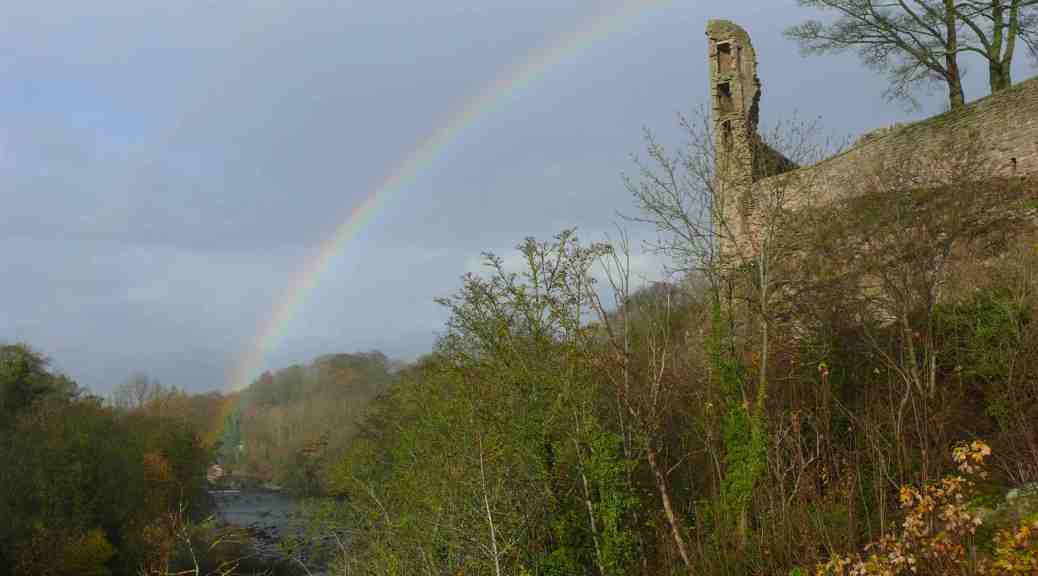
The next morning we drove round a series of amazingly beautiful ruins seeing Finchale and Egglestone Abbeys and Barnard Castle. We continue to be fascinated by history and are loving the learning and the stories we hear and read about.
We also drove past [but unable to visit as closed] the stunning medieval home of Lord Barnard set in a huge deer park. Fortunately the view from the road was superb, so we unashamedly stopped to take a photograph.
We journeyed on to our next destination of Yorkshire for what we’re sure will be a wonderful five days, exploring the home county of my mother.


 Chris and Lynda Johnson